Defining the enterprise adoption strategy
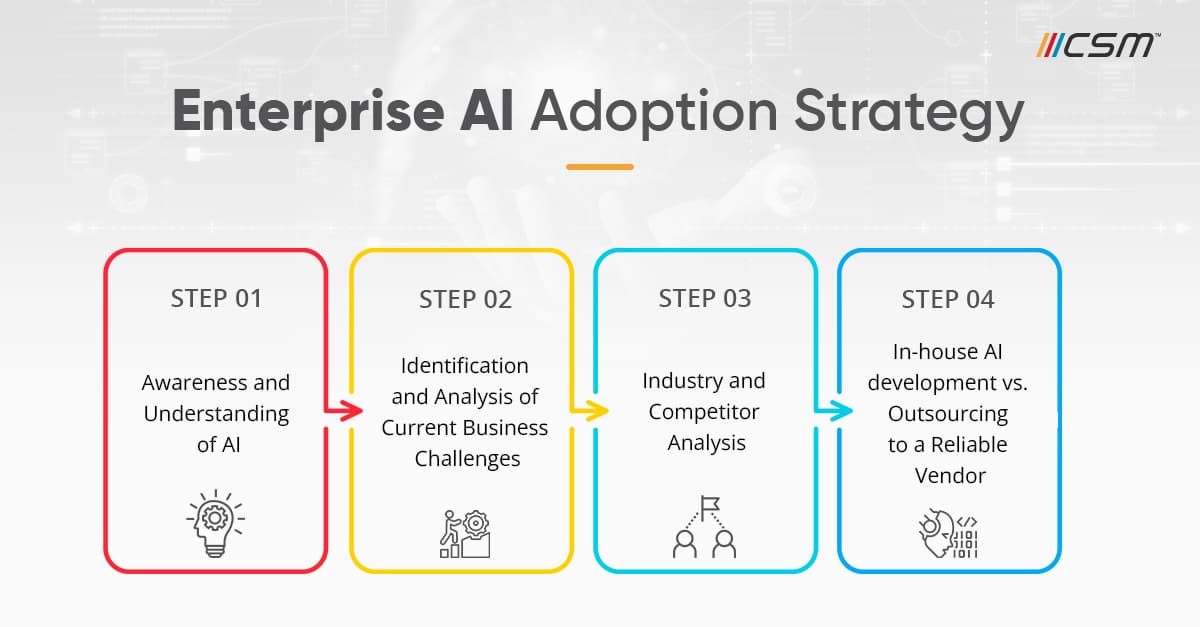
Enterprise AI adoption is the strategic integration of artificial intelligence into every layer of the business, not merely deploying tools. It is a blueprint for transforming how the business operates and competes. This distinction matters because high-stakes financial decisions require clarity on whether you are buying software or restructuring your enterprise.
A technical roadmap addresses code and infrastructure. An adoption strategy addresses people, processes, and value capture. Without the latter, technical integration often fails to deliver ROI. The goal is operational transformation, ensuring that AI capabilities align with core business objectives rather than existing as isolated experiments.
This approach requires a comprehensive framework to understand business needs, select appropriate technologies, and ensure seamless integration. It moves beyond the hype cycle to focus on measurable outcomes and sustainable scaling within complex organizational structures.
Market stakes and infrastructure shifts
The narrative around Web3 is undergoing a structural reset. We are moving away from the speculative trading cycles of the past decade toward infrastructure-heavy operations. This shift is not accidental; it is being driven by two converging forces: the insatiable compute demands of artificial intelligence and the cautious, compliance-first entry of institutional capital.
Enterprise AI adoption is no longer a pilot project. It is a strategic imperative requiring massive backend support. Recent frameworks highlight that successful integration involves understanding business needs and selecting appropriate technologies at scale. For Web3, this means the value proposition is no longer just about decentralized finance (DeFi) yields, but about providing the secure, transparent, and efficient ledger infrastructure that AI agents and large enterprises require for data integrity and automated transactions.
Institutional capital is following this logic. They are not looking for the next meme coin; they are looking for the rails that will carry the next wave of digital commerce. This creates a high-stakes environment where infrastructure providers that can demonstrate reliability, security, and regulatory compliance will capture the majority of the value. The market is rewarding utility over hype.
To understand the volatility and potential of this transition, it helps to look at the broader market context. The following chart illustrates the baseline asset performance that underpins these infrastructure plays. While speculative assets fluctuate wildly, the underlying infrastructure investments are tied to long-term enterprise adoption metrics.
Building the operational framework
Enterprise AI adoption is not merely about deploying tools; it requires a structural approach to integrating artificial intelligence into every layer of your business. This phase moves beyond pilot programs to establish the governance, data integrity, and tool selection necessary for sustainable, high-stakes operations. You are building the engine that will power your Web3 infrastructure, so the foundation must be both secure and scalable.
Governance and Data Integrity
Before selecting specific AI-driven crypto tools, you must define who owns the data and how decisions are made. A clear governance framework prevents silos and ensures that AI models are trained on verified, high-quality data. In the context of Web3, this means establishing strict protocols for data provenance and model accountability. Without this structure, even the most advanced algorithms can produce unreliable outputs that jeopardize financial integrity.
Selecting AI-Driven Crypto Tools
The market offers a variety of AI solutions, but not all are built for enterprise-grade Web3 environments. You need tools that offer transparent audit trails and real-time compliance checks. Look for platforms that integrate seamlessly with your existing blockchain nodes while providing robust security features. The goal is to enhance operational efficiency without introducing new vulnerabilities into your infrastructure.
In-House vs. Partner-Led Adoption
Deciding whether to build these capabilities internally or partner with specialized vendors is a critical strategic choice. An in-house approach offers greater control and customization but requires significant investment in talent and infrastructure. A partner-led strategy can accelerate deployment and reduce initial costs, though it may limit long-term flexibility. Your choice should align with your organization's core competencies and risk tolerance.
| Feature | In-House Development | Partner-Led Strategy |
|---|---|---|
| Control | High | Medium |
| Speed to Market | Slow | Fast |
| Cost | High Initial | Lower Initial |
| Customization | Full | Limited |
Measuring ROI and Operational Value
Moving past the pilot phase requires a shift from tracking technical metrics to measuring tangible business outcomes. Enterprises often stall here, confused by the gap between a successful proof-of-concept and a scalable, value-generating deployment. The goal is to prove that AI and Web3 infrastructure are not just cost centers but drivers of efficiency and transparency.
Start by defining clear key performance indicators (KPIs) before deployment. Instead of vague goals like "improve efficiency," focus on specific, measurable outcomes such as reduced transaction settlement times, lower operational overhead, or increased data integrity. This approach ensures that every investment can be traced back to a concrete business benefit, making it easier to secure ongoing funding and stakeholder buy-in.
To contextualize the market value and volatility often associated with Web3 assets, consider the current performance of major infrastructure tokens. These live metrics help in understanding the economic environment in which these technologies operate.
Finally, adopt a continuous feedback loop. Regularly review performance against your initial KPIs and adjust your strategy accordingly. This iterative process allows you to refine your AI and Web3 implementations, ensuring they remain aligned with your enterprise's evolving needs and delivering sustained value over time.
Final checklist for enterprise integration
Before you commit capital to a full-scale rollout, run through this sequence. Enterprise adoption is not just about deploying tools; it requires a rigorous alignment of governance, infrastructure, and human workflow. Treat this list as your pre-flight inspection.
Verify that your data pipelines meet regulatory standards (GDPR, CCPA) and that access controls are granular. Without clean, governed data, any AI layer will amplify existing biases or expose sensitive information.
Ensure your cloud or on-prem setup can handle peak loads. Test for latency and throughput under simulated production conditions. If the foundation cracks under stress, the strategy fails regardless of the software quality.
Establish baseline KPIs before deployment. Are you measuring cost reduction, speed, or accuracy? Without specific targets, you cannot determine if the integration delivers value or simply adds complexity to the stack.

Technology adoption fails without human buy-in. Conduct hands-on workshops for key users. Address resistance early by demonstrating how the tool simplifies their specific daily tasks rather than just adding another dashboard.
This checklist ensures you are building on solid ground. Skip these steps, and you risk deploying a solution that is either too fragile to scale or too disconnected from actual business needs.
No comments yet. Be the first to share your thoughts!