Defining enterprise adoption scope
Enterprise AI adoption is more than buying software licenses; it is the integration of autonomous agents into core business workflows. This shift moves organizations from experimental pilots to operational reality, where AI systems handle complex tasks with minimal human intervention. The goal is not just automation, but the creation of new efficiencies and competitive advantages that scale across the enterprise.
According to industry analysis, successful enterprise adoption drives innovation, improves operational efficiency, and reduces costs by embedding intelligence directly into daily operations. This approach enables companies to respond faster to market changes and deliver consistent value to customers. It transforms AI from a siloed technology into a fundamental component of business strategy.
To achieve this, leaders must focus on three key areas: identifying high-impact use cases, ensuring robust data infrastructure, and establishing clear governance frameworks. Without a defined scope, AI initiatives often fail to deliver measurable ROI. By aligning AI capabilities with specific business objectives, organizations can avoid common pitfalls and build a sustainable foundation for long-term growth.


As an Amazon Associate, we may earn from qualifying purchases.
Mapping the five adoption stages
Enterprise AI adoption is rarely a single launch event; it is a lifecycle. Most organizations move through five distinct phases: knowledge, persuasion, decision, implementation, and confirmation. Understanding where your team sits in this sequence helps you tailor governance and security controls to the actual risk level of each stage.
Leadership and technical teams identify the potential value of AI. At this point, the focus is on education and scanning the horizon for use cases that align with business goals. No budget is committed yet, but the groundwork for an enterprise adoption guide begins here.
Stakeholders form attitudes toward AI solutions. This is where business cases are built, and internal resistance or enthusiasm is gauged. Security teams begin to evaluate the threat landscape, ensuring that early excitement doesn't outpace risk assessment.
The organization formally commits to a specific AI strategy. This involves selecting vendors, defining data governance policies, and securing budget approval. Official guidance from providers like Microsoft emphasizes that this stage must carry strict security and governance checklists before any code is written.
The solution is deployed into the production environment. This is the most technically complex phase, requiring rigorous testing, monitoring, and integration with existing enterprise systems. Agentic AI systems, if chosen, require orchestrated oversight to ensure they operate within defined boundaries.
The organization evaluates the outcome against the initial business case. Success metrics are reviewed, and decisions are made to scale, pivot, or retire the solution. Continuous feedback loops ensure that the AI infrastructure remains secure and effective as the enterprise evolves.

Navigating these stages requires a phased plan that balances speed with safety. By mapping your current position to these five steps, you can build an enterprise adoption guide that is both realistic and resilient.
Choosing the right AI tools
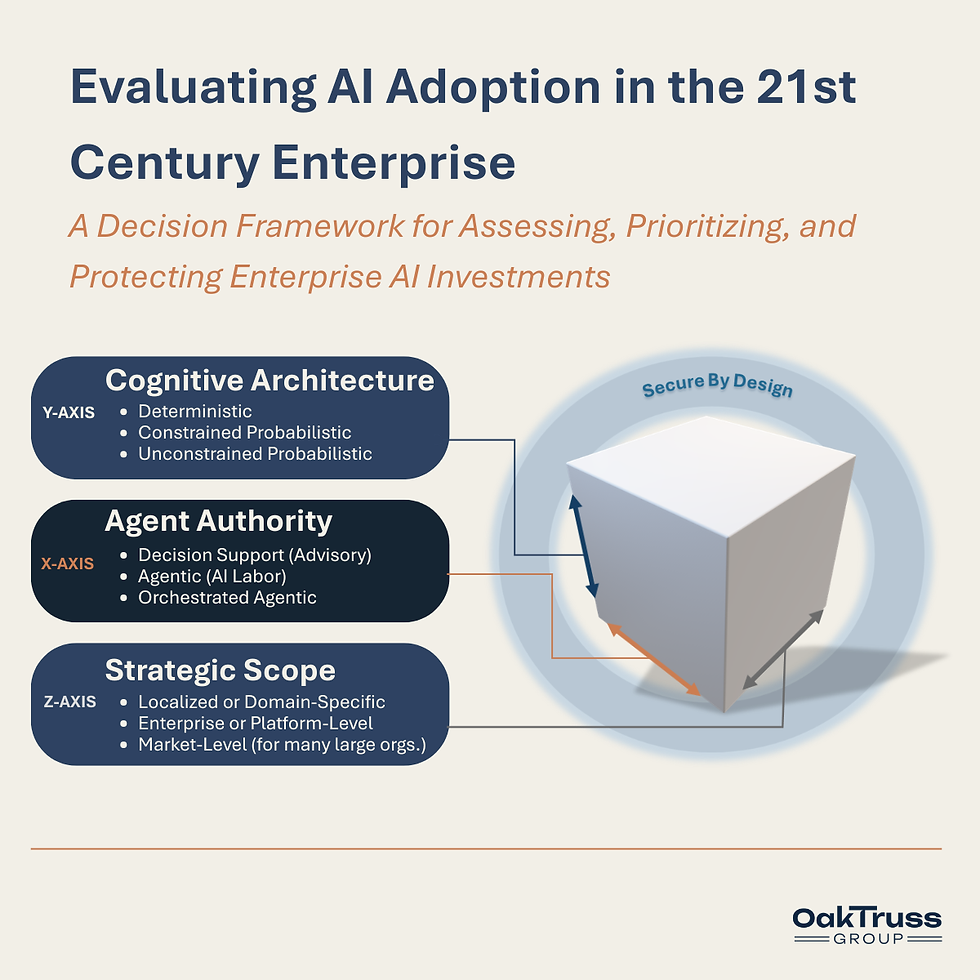
Enterprise adoption of AI is not just about buying the most advanced model; it is about matching the tool to the problem. Leaders often over-engineer simple tasks by deploying autonomous agents for routine data entry or using heavy infrastructure for straightforward analytics. To avoid this, classify potential tools by three dimensions: autonomy level, modality, and scope. This framework ensures that security and governance controls are applied appropriately without stifling innovation.
The choice between a SaaS agent, a low-code platform, and a PaaS infrastructure depends on your team's technical maturity and the sensitivity of the data involved. SaaS agents offer immediate utility with minimal setup but limited customization. Low-code platforms strike a balance, allowing internal teams to build workflows with guardrails. PaaS infrastructure provides full control for complex, high-stakes applications but requires significant engineering resources.
To visualize these distinctions, consider how each category handles autonomy and use cases. The following comparison highlights the trade-offs in flexibility, security overhead, and typical deployment speed.
| Tool Type | Autonomy Level | Best Use Case | Security Overhead |
|---|---|---|---|
| SaaS Agents | High | Customer support, content drafting | Low |
| Low-Code Platforms | Medium | Internal workflows, data aggregation | Medium |
| PaaS Infrastructure | Low (Custom) | Core business logic, sensitive data processing | High |
When evaluating these options, always prioritize the security implications of autonomy. Higher autonomy means the AI makes more decisions without human intervention, which increases the risk of errors or policy violations. For high-stakes finance and tech leadership, starting with low-code platforms for internal processes is often the most prudent path. It allows you to establish governance patterns before scaling to fully autonomous systems.
Build a secure foundation
Security and governance cannot be afterthoughts in your Enterprise Adoption guide. They must be baked into the infrastructure strategy from day one. Treating security as a final checkpoint before production is a costly mistake that creates technical debt and compliance risks. Instead, embed controls directly into the architecture where data flows and models execute.
Microsoft’s cloud adoption framework for AI emphasizes that governance decisions made during the strategy phase should carry through to production. This ensures that every decision made during scoping and launching is aligned with security protocols. When you integrate these checks early, you avoid the friction of retroactively patching systems.
This approach stabilizes the entire lifecycle. It allows teams to move faster because security is not a bottleneck but a built-in feature. By prioritizing this foundation, your Enterprise Adoption guide becomes a reliable blueprint for sustainable, secure innovation.
Empowering managers to drive enterprise AI adoption
Technology rarely fails on its own; it fails when the people meant to use it don't know how or why to proceed. In any Enterprise Adoption guide, the gap between executive strategy and team-level execution is where most initiatives stall. Managers are the bridge. Without their active support, even the most secure AI infrastructure remains a dormant asset.
Leaders must shift from simply deploying tools to actively coaching their teams. This requires a structured approach to change management that prioritizes practical application over theoretical understanding. By empowering managers to lead these conversations, organizations ensure that AI becomes a daily operational reality rather than a pilot project.
The following steps outline how to equip managers with the clarity and confidence needed to drive adoption within their specific units.
Managers need to know exactly which tools solve their team's specific problems. Rather than a generic rollout, provide managers with a curated list of AI applications mapped to daily workflows. When a manager can point to a concrete example—such as automating weekly reporting or summarizing meeting notes—they can articulate the value proposition to their team with credibility.
Abstract training sessions rarely stick. Equip managers with workshops that simulate real-world scenarios relevant to their department. This practical approach builds muscle memory and reduces the anxiety associated with new technology. When managers are comfortable navigating the tools themselves, they become the first line of support for their direct reports.
Adoption is not a one-time event but an ongoing process. Managers should be tasked with collecting regular feedback on what is working and what is hindering progress. By tracking simple metrics like usage frequency and task completion time, leaders can identify bottlenecks early and adjust their training strategies accordingly. This data-driven approach ensures that the Enterprise Adoption guide remains a living document.
Behavioral change is reinforced by recognition. Encourage managers to publicly acknowledge team members who effectively integrate AI into their workflows. This could be as simple as highlighting a success story in a team meeting or offering small incentives. Celebrating these wins creates a positive feedback loop that motivates others to follow suit, accelerating overall adoption rates.
By focusing on these practical steps, leaders can transform their managers from passive observers into active champions of AI. This human-centric approach is the cornerstone of any successful Enterprise Adoption guide, ensuring that technology serves the people, not the other way around.
No comments yet. Be the first to share your thoughts!