Enterprise adoption strategy
Enterprise adoption strategy is the structured path from pilot to production-ready infrastructure. With $37 billion invested in generative AI alone in 2025—a 3.2x increase from the previous year—the market has reached a critical inflection point. Moving beyond experimental pilots requires a framework that covers strategy, governance, technology selection, change management, and measurable ROI across the entire organization.
For crypto infrastructure, this means integrating AI-driven tools that can handle the unique volatility and regulatory complexity of digital assets. An adoption strategy is less a set of tactics and more a framework for choosing the right tools at the right moment for the right user segment. The goal is to map the operational journey so that AI agents or automated systems can execute tasks with minimal human intervention while maintaining strict compliance standards.
A practical IT strategy example in this space involves deploying AI-powered risk assessment models alongside real-time market data feeds. This approach ensures that trading algorithms or liquidity management tools adapt to market shifts instantly. By focusing on concrete integration points rather than abstract AI promises, enterprises can build scalable growth engines that are both resilient and compliant.
Enterprise adoption strategy choices that change the plan
Moving from pilot to production-ready AI-driven crypto infrastructure requires balancing speed, security, and cost. Microsoft’s Cloud Adoption Framework for AI emphasizes that every decision must carry through to production with strict governance and security controls [src-4]. This means tradeoffs are not abstract; they are concrete engineering and business decisions that determine whether your infrastructure scales or collapses under load.
Compute vs. Latency
High-frequency trading or real-time settlement systems demand low-latency execution, often requiring edge computing or specialized hardware. While this reduces transaction delay, it increases operational complexity and hardware costs. General-purpose cloud instances offer flexibility but may introduce unacceptable latency spikes during peak market volatility.
Security vs. Accessibility
Enterprise-grade crypto infrastructure requires multi-signature wallets, hardware security modules (HSMs), and strict access controls. These measures significantly reduce the risk of theft or unauthorized transactions but can slow down internal workflows. Teams often struggle with the friction between rigorous compliance checks and the need for rapid deployment of new features.
Cost vs. Scalability
Auto-scaling groups handle traffic spikes effectively but can lead to unpredictable billing. Fixed-cost dedicated instances provide budget certainty but may underutilize resources during quiet periods. A hybrid approach often yields the best balance, using spot instances for non-critical batch processing and reserved instances for core infrastructure.
Vendor Lock-in vs. Portability
Building on a single provider’s proprietary AI and crypto services accelerates development but makes migration difficult. Open-source alternatives offer portability but require more in-house expertise to maintain and secure. Enterprises must weigh the speed of proprietary solutions against the long-term risk of vendor dependency.
| Factor | Option A | Option B | Key Tradeoff |
|---|---|---|---|
| Latency | Edge Computing | Centralized Cloud | Speed vs. Cost |
| Security | HSMs & MFA | Software Keys | Friction vs. Risk |
| Cost | Reserved Instances | Spot Instances | Predictability vs. Flexibility |
| Portability | Open Source | Proprietary Services | Control vs. Speed |
Build a practical adoption framework
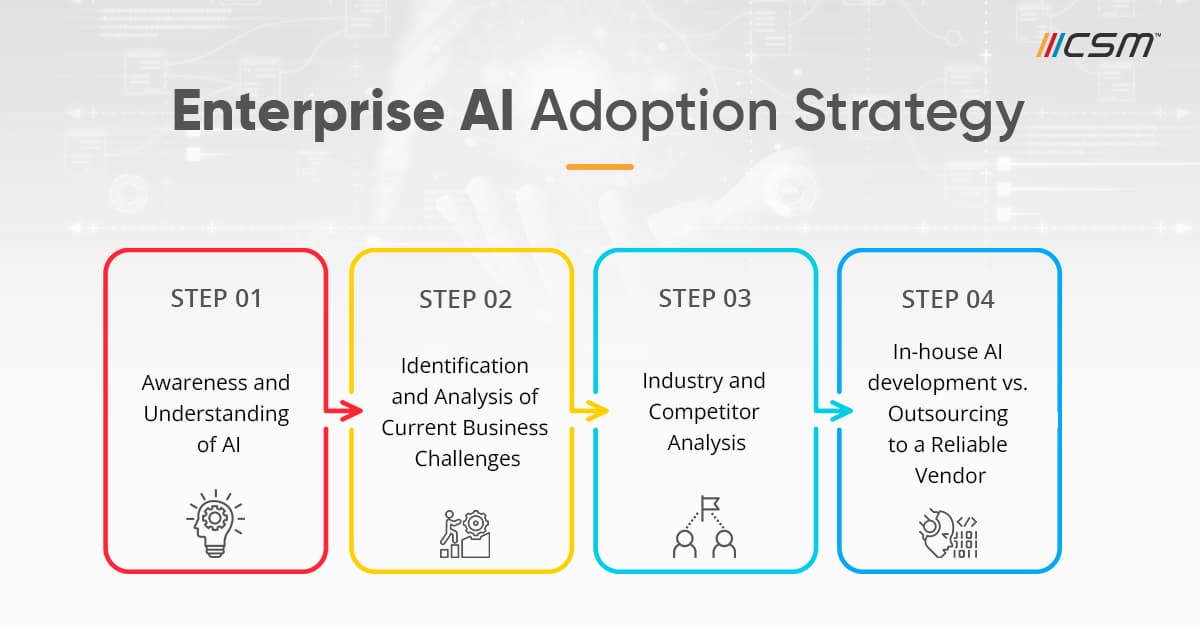
Enterprise AI adoption has reached an inflection point, with $37 billion invested in generative AI alone in 2024, marking a 3.2x increase from the previous year. This surge signals a shift from experimental pilots to production-ready infrastructure. To navigate this shift, leaders need a structured framework that covers strategy, governance, technology selection, and ROI measurement.
The goal is to move beyond scattered tools and build a cohesive system. An adoption strategy maps your user journey, designing experiences that help users achieve specific growth outcomes. It is less a set of random tactics and more a disciplined approach to choosing the right tools at the right moment for the right segment.
Start by defining clear governance policies. Identify which data can be processed by AI agents and where human oversight remains mandatory. Then, select infrastructure that scales with your transaction volume, ensuring low latency and high availability. This structured approach turns AI from a cost center into a scalable growth engine.
Map your user journey and identify high-impact use cases. Establish clear data privacy rules and human-in-the-loop requirements before selecting any vendor. This ensures compliance and builds trust with early adopters.
Choose crypto infrastructure providers that offer enterprise-grade SLAs and audit trails. Prioritize platforms with proven uptime records and robust security certifications. This foundation supports both current operations and future scaling needs.

Launch pilot programs with clear success metrics. Track efficiency gains, cost reductions, and user adoption rates. Use these data points to refine the strategy and justify broader investment to stakeholders.
Spotting Weak Options in AI Crypto Infrastructure
The promise of AI-driven crypto infrastructure is often inflated by vendors prioritizing hype over utility. Many solutions market themselves as "enterprise-ready" without addressing the specific scalability bottlenecks that define real-world deployment. Before committing to a vendor, evaluate their claims against three common pitfalls: unverified latency metrics, opaque governance models, and vague ROI projections.
The Latency Gap
A primary misleading claim is the assumption that all AI nodes perform equally under load. In reality, inference latency spikes dramatically during peak transaction volumes. Check for independent benchmarks that measure time-to-inference during network congestion, not just idle state performance. If a vendor cannot provide third-party audit logs of their throughput, treat their speed claims with skepticism.
Governance Opacity
Another common mistake is ignoring the governance layer. Enterprise adoption requires transparent decision-making protocols for model updates and security patches. Weak options often hide their governance behind proprietary black boxes. Look for open-source components or clear, auditable change management policies. Without this, you risk integrating a system that can be altered without your consent.
ROI Vagueness
Finally, beware of vague return-on-investment projections. Many proposals promise "efficiency gains" without defining the baseline. A robust strategy requires concrete metrics: cost per transaction, reduction in manual reconciliation hours, and error rate improvements. Demand case studies with specific, verifiable numbers rather than generic testimonials.
No comments yet. Be the first to share your thoughts!